
Uncategorized
From the Garage: Understanding Motorcycle Engine Oil

Aug
For many of us, motorcycle maintenance is a Zen art. It brings us into a meditative state, one often influenced by the smell of gasoline and the occasional drinking with a comrade. It’s a time for reflection and bench racing. A time to ruminate about the philosophy of speed. But even with all the enjoyment they can bring, motorcycles can be temperamental bastards. Yes, I said it. If you have a fascination with vintage, you know it can sometimes take on a mind of its own and have a power that could only be rivaled by a woman scorned. To help you get through it, I’d like to take this chance to spread a few opinions, a few facts, and a lot of philosophy on a dark and often unspoken topic.
Oil. Lubricants. The lifeblood of your machine.
If you’ve ever spent any time around a garage, you’ve most likely heard such shop talk as, ‘the dude who built mine said…,’ and ‘Old Larry only runs synthetic…,’ and my personal favorite, ‘the manual specifies…’ Well, allow me to take you through a quick look into my thoughts on the subject.
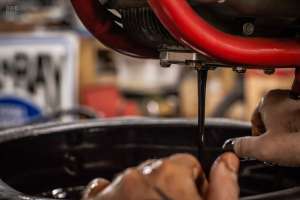
Viscosity A lot of updates have hit the lubricant market in the last few years. Minerals have been added or taken away, changes made to viscosity, and there have been new developments in breakdown prevention and detergents for modern cars and bikes. So, what should we know? Are there performance benefits in playing with different oil viscosities, brands, and types? Well, I say yes.
Unfortunately, the more you learn about it, the more confusing it gets. But for the passionate motorcyclist, some know-how on the subject may give you one more feather in your cap. Next time you’re at your friend’s garage, or the gas station while he’s running around with a generic oil in his shaking hands and screaming ‘Will this work on my bike?’ at the woman behind the counter (keeping in mind this poor lady’s last question was ‘Are those menthols on sale?’), you can step up and say, with confidence, “Well, it should get you home.”
What is viscosity? Well, most of us boast loudly that it’s that number in the center of that thingy circle! Yes, sort of. The starburst label is provided by the American Petroleum Institute (API) and really just means it has been tested by them. The second one will show us on the bottom that our oil selection meets energy conservation numbers. The one most of us pay attention to is the number in the middle from the SAE (Society of Automotive Engineers).
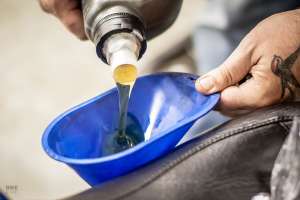
Motor oil gets thinner as it is exposed to heat and thickens as it cools. The first number (the number preceding the “W”, which stands for Winter) is the viscosity of the oil as it was tested at 0°F. The number after the dash is the viscosity as it was tested at 212°F. The complicated part is that we have developed chemicals and additives that can resist both extremes and keep them at a consistent viscosity within a wider temperature range. (For sake of space, we won’t go into all these possibilities here.) The old tale for vintage was always that thicker oil sealed better and would have a better cover of lubrication between components.
What does this all do for me? A lot. Many of the old manuals recommend oils by brand and rating and, as I’ve mentioned, a lot has changed. With some understanding of the viscosity, you may be able to get a thinner oil at startup than what was even available back then, and have the same viscosity when hot. This could help prolong engine life and even help in cooling. Some old gaskets simply will not seal as well with multi-range oils and synthetics.
These actually penetrate so well that when your ancient vintage machine gets hot or cold, she will pump through the gaskets with the movement. I have found many modern gasket alternatives and even some additives to relatively fix these issues. However, I cannot recommend leak-stopping additives. If your engine leaks, I doubt very seriously that an oil type is the cause. You will have people argue this until blue in the face, but a “seep” is way different than a “leak.” A little oil seepage to have a superior oil product is worth it. A leak should always be fixed properly.
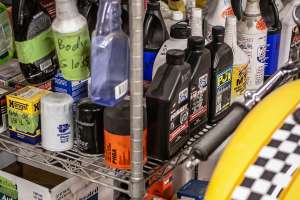
Transmission, Clutch, and Engine Now, what about my primary and my transmission? Old shit has different oil for different things. First, find out what the lubricants you will need are doing. Do your clutches need to run in the same oil?
Many modern bikes use one oil for everything, as do some Honda and Kawasaki machines, and others starting in the mid-70s. This has always been a source of confusion to new riders, as many oils do not have enough friction to allow the clutch to ever actually grab, and much misinformation has allowed people to think they can’t run synthetic or modern oils with additives or friction modifiers in their older bikes. This is just plain not true. You do need, though, to make sure the oil you are using is acceptable for transmission and clutch service. For these applications, I highly recommend anything with a 4T rating.
Without playing brand favorites, we frequently use a blend of Bel-Ray due to their wide range of performance Harley applications, which work super well for sectioned tranny and primary applications like Norton, Triumph, and BSA. (Plus, I had my Chrome Mongoose covered in Bel-Ray stickers as a kid ‘cause I was gonna be an MX champion. Damn cookie jar and Mom’s home cooking ruined that dream.) Castrol and Shell oils will work as well. I personally think you get what you pay for. In my 4T applications, I run a Synthetic-ester blend. Basically, it’s a synthetic with a very high-quality mineral-based oil mixed in. Then I use whatever viscosity is called for: 10-40 for my 675 Triumph, old KZ1000, CB750, etc.

For Harley and vintage applications, we are pretty sold on Bel-Ray. They make an air-cooled specific engine oil in semi-synthetic and full synthetic. Of course, it’s got a Harley twin on the front label so all the Neanderthals can look at the picture and grunt at the cashier, but don’t let this deter you from using it in your vintage air-cooled twin. There is one warning, however: If your Triumph is one where the engine vents through the primary and shares engine oil to cool your electronics and lube the primary chain, you need to use an oil that will work for clutches. Most synthetics will be too slick for these applications and will cause clutch slip.
Of course, old school non-detergent will work, and you could only eat French fries every day as well, but we like to get every bit we can out of our old girls. We have found the 4T oils to be excellent choices in these applications. There are multiple opinions, but we actually run a Harley spec gear oil in our transmissions, or a 50wt racing oil in some of the dirt track bikes that get checked and changed more often. The theory here is that the less resistance there is in the gearbox, the less power loss there will be. Be careful. We have found on old stuff with big tolerances that the 50wt can offer a nice mix of smooth operation and performance benefits. Lighter than this, or the old ATF trick, caused a gritty and/ or notchy gearbox.

Primary Fluid When a completely separate primary fluid is needed, we like to run a Harley-specific primary fluid. In race applications, we run ATF. Both of these give the adhesion we need for the clutch to grab and typically have a lighter weight than the old school oil recommended in the manuals (which, pretty much across the board, was a straight weight non-detergent mineral oil). The other benefit is that most of these are dyed red. It really helps in chasing down the source of seeps or leaks.
